Wednesday, September 26, 2018

Stop 4: Pitlochry (Sept. 17-19)

Of the places that we visited in Scotland, Pitlochry was probably our favorite. It wasn't a place with a lot of historical sights but it was a beautiful, lush, town with a nice downtown area. Pitlochry would be a good place to live (not that we're considering moving to Scotland).

Our train trip to Pitlochry was interesting. This was the only instance where we had first class tickets but strangely, the seats were unassigned. I asked about this and was told that all first class seats were assigned except for 9 seats in the compartment closest to the engine. Since there was no way of knowing how many people would be vying for those seats, we were advised to make a beeline for that compartment the second that they announced the platform. We did and got 2 of the 3 forward facing seats (the other seats were all facing backwards).


Before long, 2 American couples came along and insisted that, because there were 4 of them, they should be entitled to the 4 seats that faced each other across the table. We told them that they'd be welcome to our seats after Pitlochry. Then they proceeded to bring in enough luggage for an around-the-world cruise. Amazing what people think they can bring on a train (train travel was the primary reason that we went with small backpacks). The conductors were very clear about them not putting it in the aisle so they ended up riding on top of it.

Most of the stations, including Pitlochry are entry points for the Cairngorm National Park. We expected to have to walk a couple of blocks to get to our hotel but it ended up that a short gravel path ran from the train station to the back door of the hotel.

One of our first missions was a walk down to Tourist Information to find out just what there was to see.


On the way to the TI, we passed this beautiful pocket park.


The garden next door to the TI included this interesting woven stick figure. The TI is the building on the far right. The white building behind it is a place called Heathergems. They dye heather and then bundle different color combinations, soak it in resin and bake the bundles. The result is something that they can slice, shape, polish and put into jewelry. Very nice stuff.

Took this picture just to show all the chimney pots.

The TI recommended 2 distilleries (one of witch looked impossible to walk to safely) and a walk to the Pitlochry Hydroelectric Dam and Fish Ladder. We did the dam walk first.

After walking through a beautiful neighborhood with dense growth and running water everywhere, we came to this suspension bridge over the River Tummel.

Looking upstream at the dam. The first building on the left is a hotel. The building behind it is a performing arts center.

Getting closer to the dam. That's the powerhouse on the left.

Closer. That is a part of the fish ladder in the lower left.

The fish ladder. The water is very brown because of the peat that it flows through.


Looking downriver from the dam.

Water flowing over the edge.


From the visitors center. A couple of girls walked out an alarmed door while we were here and they evacuated the entire place and moved everyone up to the parking lot.
Our last stop was the Blair Athol Distillery. All of the tours were booked up but the tasting room was open. All of these tasting rooms serve a large variety of whiskeys from across Scotland.

Blair Athol Distillery.

The bar in the tasting room was manufactured from an old copper Mash Tun.

-JC-

Tuesday, September 25, 2018

Stop 5: Glasgow (Sept. 19-21)

We had an interesting time getting from Pitlochry to Glasgow. Our train trip involved a leg from Pitlochry to Perth and a second leg from Perth to Glasgow. Complicating this, Storm Ali hit with heavy rains and 80-100 MPH winds.

When we arrived at the Pitlochry station, we learned that one of the trains had suffered a "low speed derailment" to the north of us. The buses that had so far run as substitutes for the trains had all bypassed Pitlochry because they were full. We were encouraged to wait for the next one or, if we were willing to wait 2 hours, there was the possibility of a train. This sounded a bit iffy so we walked back to our hotel and had them call us a cab.

The cab got us to Perth in time for our connecting train but quickly learned that it was "delayed" because of downed trees on the track. As the delay continued, we noticed that most of the other trains were being shown as cancelled. We briefly considered traveling to Glasgow via Edinbourgh when a man approached us (probably because of our minimal luggage) and told us that he had a cab coming to take him to Glasgow. He wanted to know if we'd like to share the cab and we said yes!

The taxi dropped us at Queen Street Station, our original destination. We were actually ahead of schedule. Looking at the board in the station, it looked as if every train in the system had been canceled. We found out later from one of the Tourist Information people that people had been stranded all over Scotland with no rooms or taxi cabs available. Looks like we did good.

By that point we were out £155.20 (£40.20 for the unused tickets, £45 for the 1st taxi and £70 for our share of the 2nd taxi. It made sense to apply for a"delay of travel" refund. We'll see how that goes. If we get nothing back, we at least got to where we needed to be.


UPDATE: Received an email yesterday that Scotrail is refunding £85.20. Apparently, there was a free bus option that we were unaware of between Perth and Glasgow. Getting from Pitlochry to Glasgow ended up costing £70 instead of the £40.20 that we'd originally planned.Not too bad, considering. Next challenge will be to cash their £85.20 check at the bank.

For our one full day in Glasgow, we decided to do the CitySightseeing Glasgow Hop On Hop Off double-decker bus tour. We rode the circuit once (lousy seats downstairs so no pictures) just to see what we might want to revisit.

When we took a break for lunch, we decided to see the marble interior of City Hall before getting back on the bus.

Looking across the front of City Hall

Spectacular interior.

More spectacular interior.
We got good seats upstairs at the front when we got back on the bus,

Glasgow Cathedral.

Clock Tower.
There was a lot to see near the Peoples Palace so that was our first stop.

The Peoples Palace.

Peoples Palace and Winter Garden.

Inside the Winter Garden (it looked like they were preparing for a wedding).

Inside the Winter Garden.

Inside the Winter Garden.

This fountain outside the Peoples Palace is obviously a replica of the Queen Victoria statue outside the gates of Buckingham Palace.

This is the Templeton Carpet Factory. Because it faces out onto the park around the Peoples Palace, the builders had to make it look like the Doge's Palace in Venice.
Nelson's Column (predates the one in Trafalgar Square).

Some wind damage from the previous day's storm.
Back onto the bus...

Most of the Italian designers are located in this building. This statue was molded from chopped up credit cards.

The Gallery of Modern Art.


Our next stop off the bus was to tour the Clydeside Distillary and sample the whiskey. This distillery is so new that it's product is still in the casks and has yet to be released.

The stills.

The tasting. This was the only distillery that wouldn't tell us what we were sampling. Instead, it more of a class to tell us what we should be looking for when we taste.

Took this picture from the still room. This clipper is moored at the Riverside Museum.

Also taken from the still room. This is the original Queen Mary. We were told that the Queen Mary that is in Long Beach was supposed to be called the Queen Victoria. When they invited the King to christen the ship, they told him that it was to be named for Britain's greatest Queen. The King said that his wife would be overjoyed at the news. The name was suddenly changed.

-JC-

Monday, September 24, 2018

Stop 6: Reykjavik (Sept. 21-25)

Our hotel in Glasgow had an interesting way of calling a taxi. After pushing a button in the lobby and noting the reference number on the display, we waited at the curb. After confirming the reference number, we were off to the airport.


Glasgow airport had the largest duty free area that we'd ever seen. The serpentine walkway seemed to go on forever. I had to take a few pictures.


Finally, the waiting room where we watched the screens for the gate announcements.

We soon realized that those shops were a good way to get rid of our last 30 pounds. We bought a small bottle and a tiny bottle of 2 very good single malts. Something to enjoy in Reykjavik.

We had 3 full days in Iceland. We decided to explore Reykjavik on foot the first day and then take a couple of bus trips on the second and third days.


Day 1: Exploring Reykjavik


After breakfast at the hotel, we walked the couple of blocks over to the ocean (North Atlantic) and then walk down to the old harbor.

It's difficult to distinguish the clouds from the glaciers. By the time that we left Reykjavik, the hills were covered in snow.

Kristen and the Sun Voyager. We didn't realize it at the time but the place where Reagan met with Gorbachev in 1986 (in the former British consulate called Höfði) was right across the street from here.

A beach covered with cairns.

Harpa Concert Hall.
We continued on around the old harbor, visited a whaling museum (mostly because it had a public bathroom) and the worked our way inland to find the original settlement which was a well documented, underground, archaeological dig.

By then, it was time for lunch so we found one of the restaurant/shopping streets and had something to eat.

This might be a good time to mention the high prices in Iceland. An Icelandic Krona is worth 88/100 of a CENT (not a dollar, a CENT). The easiest way to estimate how much you're spending is to lop off 2 zeros. Even then, the prices are incredibly high. The total for a typical dinner looks like it would buy a car. Before we left the airport, we stopped at the ATM to get $50 (approx.) worth of Krona. I pushed the button that said 50.000 (that's not a decimal - that was 50,000 krona or $500+). We operated on a cash basis most of the time that we were in Iceland.

After lunch, we explored the main shopping street, Laugavegur (our hotel was at the far end from where we had lunch). Along the way, we spotted what everyone calls "the Tall Church" up a side street (also a shopping street).

Halldrimskirkja (Lutheran church)

The interior is very plain with the exception of the organ pipes. Some of the pipes look like they belong on some ultimate hot rod.
Lief Erickson statue in front of the church.

The inscription behind the statue.
After resting up and enjoying happy hour at the hotel, we headed back down Laugavegur to explore the section that we had bypassed to go to the church and find some dinner.


Day 2:Golden Circle Tour (8 Hours)


Þingvallavatn (in Þingvellir National Park) is the largest lake in Iceland.


Closeup of the geothermal plant on the far side of the lake. Plants like this provide much of Iceland's heat, electricity and hot water.
Þingvellir National Park includes the rift valley where the American seismic plate meets the Eurasian seismic plate.


Looking out over the rift valley from the edge of the American seismic plate.. The Eurasian plate in the distance is much less pronounced

Still on the edge of the American plate.

The drowning pool: As long as everyone followed the Norse Gods and then Catholicism, there was no need for a death penalty. Once they all became Lutherans (religion was prescribed by law), a death penalty was needed. They had many creative forms of execution for the men. The women were held under water in this pool. That's ice floating in the pool.

The water flowed off the edge of the American plate down into the drowning pool.

Looking up from the rift at the edge of the American plate.

Looking across the rift.


That fall eventually feeds the drowning pool.


Lögberg (Law Rock) in Þingvellir, is where Iceland's Althing parliament was formed. Much later, they declared their independence at (what might have been) the same site.


The Prime Minister keeps a home at Lögberg for special occasions.

The flag marks where they think the Law Rock was.


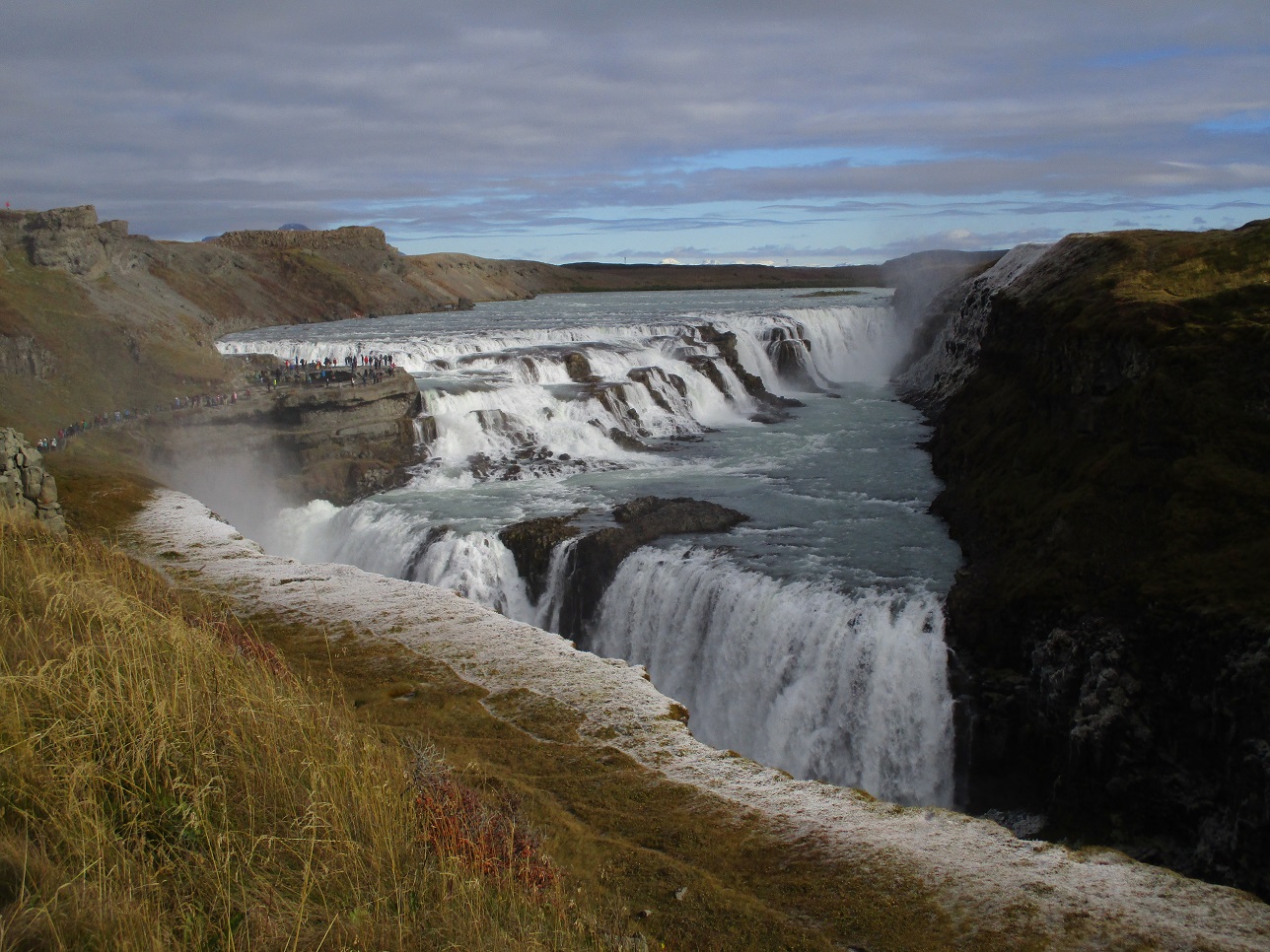
Our next stop was Gullfoss (Golden Falls - lends its name to Golden Circle)


See how golden the falls are? 😄


Views of he distant glaciers from the parking lot at Gullfoss. We had some terrific Lamb Stew at the restaurant here.


The horses in Iceland are a smaller variety that goes back to the original settlers. There are currently about 80,000 horses in Iceland for a human population of about 317,000. We stopped to visit with a few of them.

The horses pretty much run wild and stay out through the Icelandic Winter. By the next day, they were starting to come together into their Winter herds and the males were working to establish their place in the herd.


Our next stop was a geyser basin (very Yellowstonelike).


Kristen at Geysir. Geysir has given its name to all geysers but it has gone quiet and rarely erupts.

Geysir pool again (without Kristen)

Strokkur has taken Geysir's place. It erupts every 10 minutes or so and can be 50 meters high. This is Strokker from a distance.

We waited patiently for Strokker to erupt but, on a cold day, we got mostly steam.


The next waterfall was Faxi.


Faxi had an interesting fish ladder.


I'm not sure what the significance was but our next stop was an Episcopal Cathedral at Skálholt. There was a tomb down stairs for a slain bishop so maybe being Episcopal was a crime (?).


Wood construction was unusual in Iceland (no trees) and they tended to burn down. We were told that most wooden churches had a spare sod building next door so they'd have a place to meet after they got careless.


This roof made me think of the mowing job that awaited me at home.

No pictures here but we passed through a town called Hveragerdi. It was located in one of the most seismically active parts of Iceland so that they could take advantage of the geothermal vents to heat their many green houses). Several miles before Hveragerdi, we had a small church pointed out to us because of its very large cemetery. It seems that they don't bury people at the churches in Hveragerdi because the coffins will boil and, at the next earthquake, come flying out of the ground.

Our final stop was a bathroom break at a former Ski Lodge. It had a lot of interesting geothermal stuff.


Day 3: South Iceland Waterfalls and Black Sand Beach (10 Hours)


There's always somebody:

On our Golden Circle tour, we'd had a group of 3 women who had each grabbed window seats and insisted on conversing with each other over the heads of the other passengers. That, combined with the fact that they were late back to the bus a couple of times put them on a lot of peoples S-list.

On this tour, we had a couple who did at least sit together but they managed to be 10-15 minutes late getting back to the bus at every single stop. The rest of the bus was ready to leave them behind.

Enough of my complaining ...

Our first stop was Skógafoss.


Skógafoss

The path to the observation platform near the top of the falls.


That's me!


Pretty peak off to the side of Skógafoss.

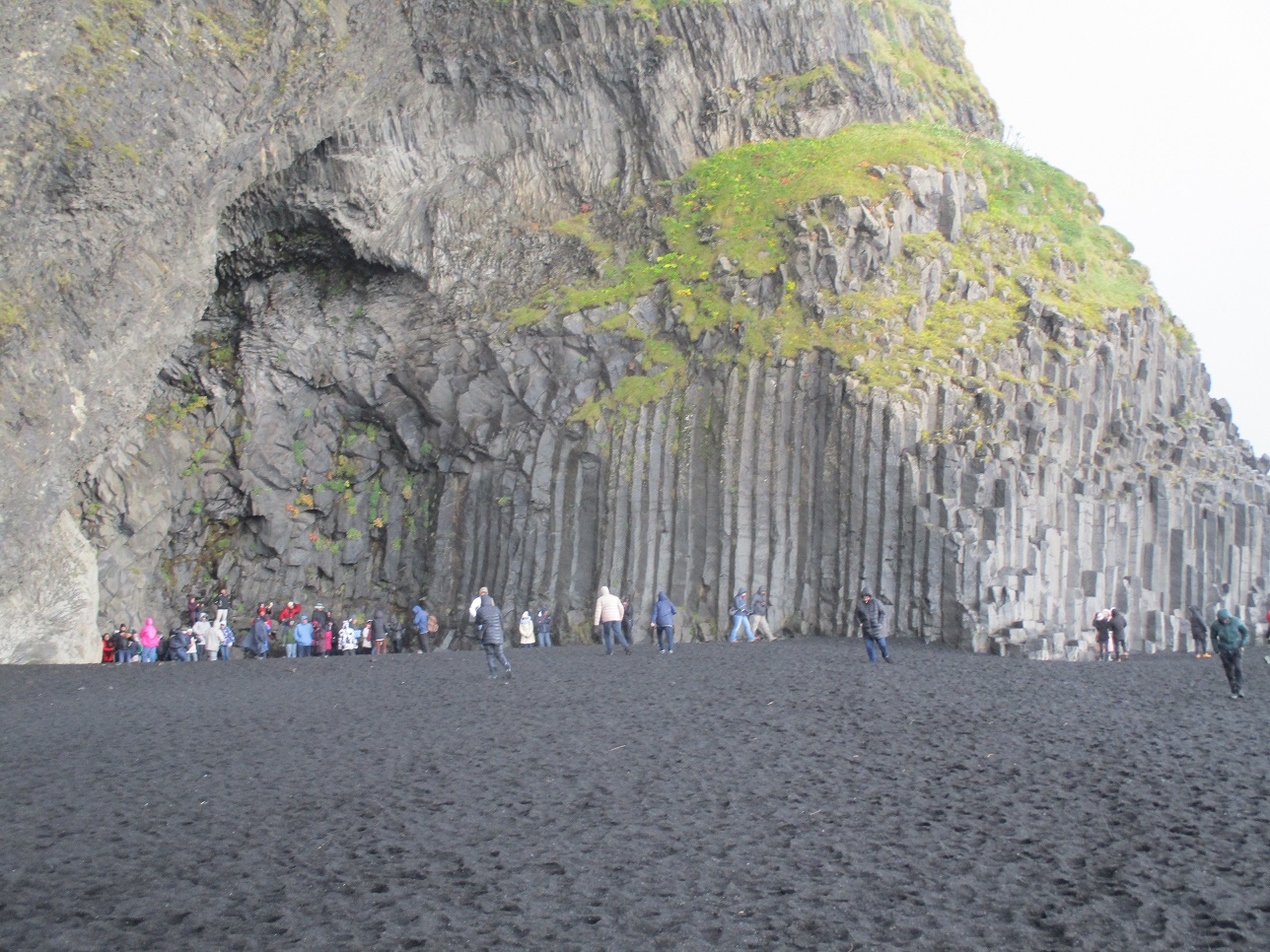
Out at the farthest extent of our trip we had lunch at Vik Village and then visited nearby Reynisfjara with its black sand beach and awesome sea stacks. We had no sooner left the bus when the sky opened up with a horizontal mix of sleet and hail that came at us at gale force.  We pointed our umbrellas into the wind and saw what there was to see. Just as the sleet/hail died, the wind put on one final huge burst and absolutely destroyed our umbrellas (pointed into the wind, our umbrellas collapsed down around the handles).

A picture of the surf (This was just as the gale hit - people hadn't fled yet.).

This cliff formation is similar to Devils Postpile in California. A matrix of hexagonal lava columns. Notice how many people have taken shelter in the lee of the cliff.

These sea stacks are what's left of vertical lava tubes. The softer material eroded leaving the hard lava. These, and other sea stacks were also visible from Vik Village (where we had lunch). This was right at about the time that the gale gave its last gasp and destroyed our umbrellas.

Sea stacks, cliff and beach from a distance. Safe for people to be out now.

Interesting rocks off in the other direction. The hole is called he door (in Icelandic of course - Með?)


Sheep above Reynisfjara. Iceland has about 800,000 sheep (323,000 humans). They pretty much roam free but need to be brought indoors for the Winter. We did see some of the first snows while we were there so I guess it was time to gather the sheep. High up this very steep hill, we could see the dogs at work.

I obviously took this photo from the bus. It must have been because the colors were so unusual on this hill.


We next stopped at Skaftafell Nature Preserve where we walked out to Falljökull glacial tongue (part of Europe's largest glacier, Vatnajokull).

Falljökull glacial tongue.

I think that's a waterfall at the far side.

The melt flows through this iceberg covered lake.


Taken from the bus: We saw many of these farm buildings that were built back into the cliffs.
Our final stop was Seljalandsfoss, a waterfall that you can walk behind (if you don't mind getting wet).


Seljalandsfoss and its neighbors from a distance.

Closer up.

Behind the falls (at least this was as far behind the falls that I got - did I mention that it was wet?)

The falls from the other side.
UPDATE (only because I didn't think of it it earlier): All around Southern Iceland, we saw large flocks of swans. We were told that they were waiting for the winds to change so that they would be helped along on their way to Britain. In the past, they've put trackers on some of the swans. With a favorable wind, they can make it to Liverpool in 8-10 hours,

-JC-